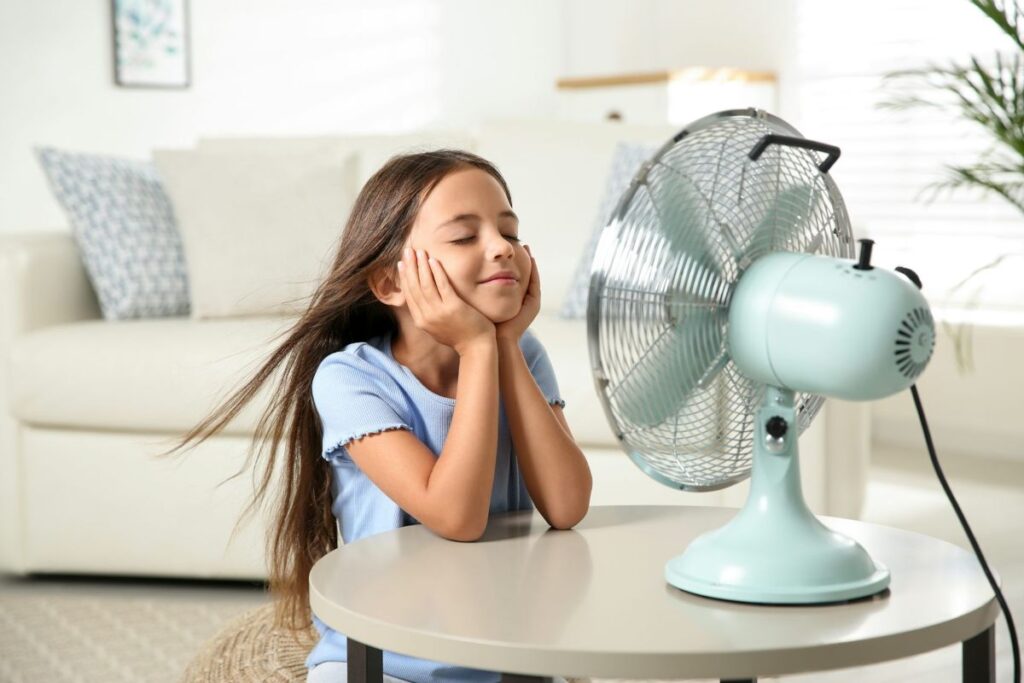

A typical electric fan uses between 20 and 100 Watts, depending on the type and speed. That equals about 0.02–0.1 kWh per hour, so running a fan usually costs just a few pence per hour in the UK. Over 24 hours most fans consume roughly 0.5–1.5 kWh, far less than an air conditioner.
As energy bills remain a concern for households across the UK, many people are looking more closely at everyday appliances and how much power they really consume. Fans are often seen as a low-cost alternative to air conditioning, but have you ever wondered how much electricity a fan actually uses? Whether you rely on a standing fan in your living room, a compact desk fan in your home office, or a modern ceiling fan in your bedroom, understanding their electricity use can help you manage your energy consumption more efficiently.
In this detailed guide, you’ll learn how fan power is measured, the differences between common fan types, what it costs to run one per hour, overnight, or in 24 hours, and how you can reduce your energy usage even further.
Understanding how electricity use is measured
Before jumping into exact figures, it’s important to understand a few basic electrical terms. Power is usually measured in Watts, which shows how much energy an appliance uses while running. Fans generally use far fewer Watts than heaters, tumble dryers or air conditioners, which is why they are considered energy-friendly.
When calculating power consumption, you might also come across volts, Amps, and ohms. Ohm’s Law links these. In simple terms:
- Volts represent the pressure of electricity.
- Amps represent the flow of electricity.
- Ohms represent resistance.
In most UK homes, the voltage is around 230 volts. The lower the Amps and Watts, the less electricity your fan is using.
How many Watts does a fan use?
The amount of electricity a fan uses depends on its type, size, motor quality and speed setting. Let’s look at the most common kinds found in UK homes.
- Desk fan is one of the most energy-efficient options. It usually consumes between 20 and 40 Watts. These small fans are ideal for personal cooling, especially on office desks, bedside tables, or in study rooms.
- Standing fan, also known as a pedestal fan, normally uses between 40 and 70 Watts, depending on its size and power level. These are popular for bedrooms and living areas because of their adjustable height and wide airflow.
- Ceiling fan typically uses between 15 and 75 Watts, depending on the speed and model. Modern, energy-efficient ceiling fans may use even less, especially those with DC motors.
- Dyson fan, or other bladeless fans, often use slightly more electricity due to their technology and features. On average, they can draw between 30 and 100 Watts, depending on the settings and functions being used, such as oscillation or air purification.
- Kitchen extractor fan typically runs between 20 and 50 Watts, though powerful cooker hood fans can go higher. These fans are designed to remove steam, smells and grease from the air, not necessarily to cool a room.
Compared to other household appliances, even the highest-wattage fan uses very little power.
How much electricity does a fan use per hour?
To calculate how much electricity a fan uses per hour, convert watts to kilowatts by dividing by 1000. For example:
- A 50-Watt fan uses 0.05 kilowatts per hour (50 ÷ 1000 = 0.05 kWh)
- A 30-Watt fan uses 0.03 kWh
- A 75-Watt fan uses 0.075 kWh
If your electricity unit rate in the UK is around 28p per kWh (this can vary by supplier and region), the cost looks like this:
- 50-Watt fan: Around 1.4p per hour
- 30-Watt fan: Around 0.8p per hour
- 75-Watt fan: Around 2.1p per hour
This shows that running even a large fan costs just a few pence an hour, making it extremely affordable.
How much does it cost to run a fan overnight?
Many people like to leave their fan running while they sleep during warmer months. How much does it cost to run a fan overnight, say for 8 hours?
Let’s use a 50-Watt standing fan as an example:
- 0.05 kWh × 8 hours = 0.4 kWh per night
- 0.4 kWh × 28p = 11.2p per night
Even over a whole month, that only comes to around £3.36. This means you can stay cool and comfortable without worrying about a high electricity bill.
If you use a more efficient desk fan at 30 Watts:
- 0.03 kWh × 8 hours = 0.24 kWh
- 0.24 kWh × 28p = around 6.7p per night
Over 30 days, that’s roughly £2 – an incredibly low cost for better sleep.
Electricity use in 24 hours
If you were to run your fan continuously for 24 hours, the amount remains relatively small.
Using the same 50-Watt fan:
- 0.05 kWh × 24 hours = 1.2 kWh per day
- 1.2 kWh × 28p = around 33.6p per day
Even at constant use, a fan is significantly cheaper than an air conditioner, which can use 1,000 to 3,000 Watts per hour.
A ceiling fan running at 40 Watts would use:
- 0.04 kWh × 24 hours = 0.96 kWh
Cost: around 26.8p per day
This makes ceiling fans an excellent long-term cooling solution for hot weather.
How Much Electricity Do Different Fans Use?
| Fan Type | Watts | Cost per Hour | Cost in 24 Hours | Best For |
|---|---|---|---|---|
| USB Fan | 2 – 5 W | Less than 0.2p | Less than 5p | Laptops, travel |
| Desk Fan | 20 – 40 W | 0.6p – 1.1p | 17p – 27p | Work desks |
| Standing Fan | 40 – 70 W | 1.1p – 2p | 27p – 47p | Bedrooms, lounges |
| Ceiling Fan | 15 – 75 W | 0.4p – 2.1p | 10p – 52p | Whole room |
| Window Fan | 50 – 120 W | 1.4p – 3.3p | 34p – 85p | Ventilation |
| Kitchen Extractor Fan | 20 – 50 W | 0.6p – 1.4p | 17p – 34p | Kitchens |
| Dyson Fan | 30 – 100 W | 0.8p – 2.8p | 27p – 67p | Modern homes |
| Industrial Fan | 100 – 250 W | 2.8p – 7p | 67p – £1.68 | Warehouses |
| Mist Fan | 75 – 200 W | 2.1p – 5.6p | 50p – £1.34 | Outdoor spaces |
| Blower Fan | 200 – 500 W | 5.6p – 14p | £1.34 – £3.36 | Strong airflow |
Factors that affect a fan’s electricity consumption
Several factors can increase or decrease how much electricity your fan uses:
- The speed setting plays a big role. Higher speeds require more power, increasing the number of Watts used per hour. A fan on the lowest setting may consume about half as much electricity as one running at full speed.
- The age of the fan also matters. Older motors are often less efficient and draw more Amps than newer, energy-efficient models.
- Dust and maintenance can affect performance, too. A clogged or dirty fan has to work harder, increasing electricity use. Regular cleaning helps keep the motor running smoothly.
- Features such as remote controls, timers, air filtration, and LED displays can also slightly increase electricity consumption, especially in premium models like a Dyson fan.
Is a fan cheaper than an air conditioner?
Without question, yes. An air conditioning unit can use between 1,000 and 3,000 Watts. That is 20 to 40 times higher than the power of a standard fan.
For example, an air conditioner using 2,000 Watts will consume:
- 2 kWh per hour
- 2 kWh × 28p = 56p per hour
In comparison, a 50-Watt fan costs just 1.4p per hour. Over a long summer, this difference can save you hundreds of pounds in the UK.
This is one reason interior planners and energy-conscious designers, The Home Designer, often recommend incorporating fans into modern home layouts to enhance comfort and efficiency.
Which fan is most energy efficient?
If your goal is to keep electricity usage as low as possible, the most efficient options are:
- A high-quality ceiling fan with a DC motor distributes air across the whole room while using minimal power.
- A desk fan is ideal for personal use in small areas, as it doesn’t waste energy on unnecessary space.
- In larger rooms, a well-positioned standing fan can cool more effectively without needing to turn the speed up too high.
- While a kitchen extractor fan isn’t designed for cooling, using it correctly while cooking can reduce heat build-up, so you won’t need to rely on a more powerful cooling device later.
Tips to reduce your fan’s electricity use
There are simple ways to make your fan even more cost-effective:
- Choose energy-efficient models with low Watt ratings. Look for Energy Star ratings where possible.
- Clean the blades and grills regularly to improve airflow and reduce motor strain.
- Use the timer function if your fan has one, especially when running overnight.
- Try using the fan alongside open windows to create natural cross-ventilation.
- Switch off the fan when the room is empty to avoid unnecessary power consumption.
Final thoughts
So, how much electricity does a fan use? The answer is: far less than most people expect. Whether you’re using a desk fan in your home office, a standing fan in your living space, or a quiet ceiling fan in your bedroom, the cost remains extremely low – just a few pence per hour, even when running overnight or for 24 hours.
Understanding Watts, Amps, volts and ohms might seem technical, but it gives you greater control over your household energy choices. In the UK, where energy prices continue to fluctuate, small decisions like choosing a fan over an air conditioner can make a meaningful difference to your monthly bills.
If you’re looking for a simple, affordable and effective way to stay cool, a fan remains one of the best and most energy-efficient solutions available.
Frequently Asked Questions
How much electricity does a fan use in 24 hours?
On average, a fan uses between 0.5 and 1.5 kWh in 24 hours, depending on the type and speed setting. This typically costs 15p to 40p per day at standard UK electricity rates. A ceiling fan or desk fan may cost even less than this.
Is it expensive to run a fan overnight?
No, running a fan overnight is very affordable. A standard fan running for 8 hours usually costs between 6p and 20p per night in the UK. Using a timer or a low-speed setting can further reduce this.
Does fan speed affect electricity consumption?
Yes, fan speed greatly affects how much electricity is used. A fan on the highest setting can use up to twice as much power as running it on low or medium. Choosing a moderate speed helps maintain comfort while keeping energy usage low.
Which fan uses the least electricity?
A USB fan and a low-watt ceiling fan use the least electricity, often consuming less than 30 Watts. These are ideal for people who want a cooling solution that has minimal impact on their electricity bill.